ServicesThe Discovery approach

AI SEO research: see how AI recommends your brand

Your customers increasingly start their research in AI assistants instead of a search engine. We observe real people using AI tools to choose a provider, then show you how AI positions your brand against competitors - and what to do about it.

Observed using AI tools. No AI respondents
Real people
From the first prompt to the brand they trust
Full journey
AI visibility across your competitors
Benchmarked
Payment upon delivery*
No upfront fee

*In certain scenarios, depending on the country and scope of the project, a partial upfront fee may be requested, but we always aim to avoid this wherever possible.

What you learn

How AI decides which brands to surface

We study real human behaviour inside AI tools, not algorithms in a vacuum. Participants complete real-world tasks using only AI assistants, and we analyse both their behaviour and the answers the AI gives them.

Positioning.
How AI systems position your brand versus competitors.
Language.
What specific terminology customers use when evaluating options.
Visibility triggers.
When and why your brand appears, or doesn't, in AI responses.
High-intent prompts.
The natural-language prompts that drive brand discovery in your category.
AI Discovery Analysis0 sessions

Participant responses

#42“Which insurance platform is easiest to compare policies on?”

ChatGPT recommended InsureCompare first, describing it as "the most intuitive side-by-side comparison tool" - ahead of two other providers.

Aggregate AI visibility score

Your Brand
74%
Competitor A
61%
Competitor B
48%
Competitor C
35%

Why it matters

Ranking first on Google isn't enough

Traditional SEO optimises for rankings. AI assistants work differently: they synthesise answers instead of listing links, recommend specific brands, and interpret complex intent rather than matching keywords.

You can rank #1 on Google for a high-value keyword and still be invisible in a ChatGPT or Gemini recommendation. Search is no longer only about being found; it's about being recommended.

How it works

Our methodology, AI Discovery Mapping, studies real people inside real AI tools.

  1. 01

    Study design

    We define the category, the competitor set and the participants who match your customers.

  2. 02

    Real-world AI tasks

    Participants complete real tasks using only AI assistants, starting from prompts like 'What are the best options for [service]?'

  3. 03

    Tracking and analysis

    We track how each prompt evolves, which brands the AI surfaces, and what ultimately secures the user's trust.

  4. 04

    Your AI visibility plan

    You receive clear, prioritised actions to improve how AI assistants present your brand against competitors.

What you receive

  • AI search journey map

    How your customers move from their first prompt to the brands they trust, and where you appear along the way.

  • Competitive AI positioning

    Which brands AI assistants surface prominently and why, and how they frame you against your competitors.

  • Actionable AI visibility insights

    What influences visibility, perception and click-through, and what to change first.

Run it on its own, or within the Tetrabase Framework alongside competitive benchmarking, to see AI signals and journey experience in one view.

See it in practice

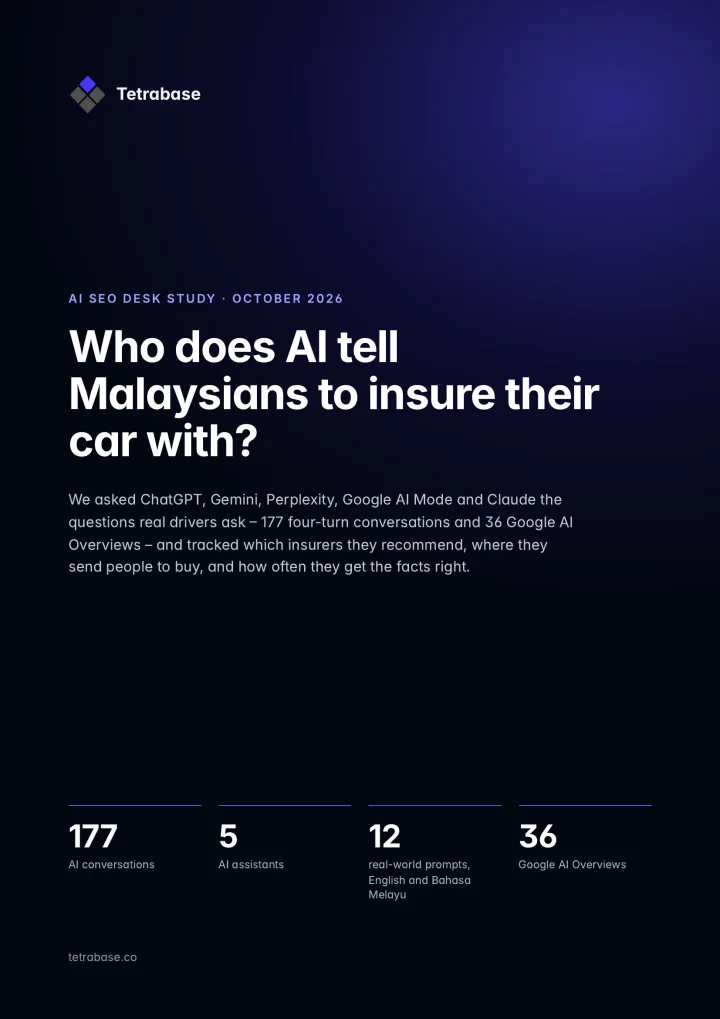
  • AI SEO desk study · Car insurance, Malaysia ·

    We asked five AI assistants which car insurer to choose. They couldn’t agree.

    We asked ChatGPT, Gemini, Perplexity, Google AI Mode and Claude which car insurer a Malaysian driver should pick. 177 conversations later, they couldn’t agree.

    AI conversations
    177
    AI assistants
    5
    Real-world prompts, English and Bahasa Melayu
    12
    Google AI Overviews
    36

    Read the case study

Frequently asked questions

What is AI SEO research?

Research into how people use AI assistants such as ChatGPT and Gemini to discover and choose brands, and how those assistants present yours. Traditional SEO focuses on search rankings; AI SEO research focuses on being recommended.

Is AI SEO the same as GEO or AEO?

Largely, yes. AI SEO, GEO (generative engine optimisation) and AEO (answer engine optimisation) all describe the same goal: being found and recommended in the answers of AI assistants such as ChatGPT, Gemini and Perplexity. Our research gives that work its evidence: how real people prompt, which brands the AI surfaces, and what to change first.

What is "In-person AI Empirical Research"?

This is a specialized form of usability testing where we observe in real-time how users interact with AI tools to discover your brand or your competitors. We analyze prompting habits and search intent to understand how users find information before they even reach you.

Which AI assistants do you study?

The ones your customers use to research providers like you, such as ChatGPT, Gemini and Perplexity.

Do you use real participants?

Always. Every answer comes from a real person in your target audience: no AI-generated or synthetic respondents, ever.

Can we combine it with competitive benchmarking?

Yes. The Tetrabase Framework combines AI discovery mapping with competitive journey benchmarking, so AI signals and journey experience are unified in one view.

What languages can the research be conducted in?

Any language. We run each study in your participants' own language, and their answers are then translated into English for our analysis.

How is pricing structured?

Every study is scoped to your research objectives and participant requirements, so investment varies by project. We'll walk through a clear estimate during your discovery call. We don't charge an upfront deposit or retainer: payment is made once your results are delivered (in some countries or scopes, a partial upfront fee may be requested).

Ready to transform your user experience?

No obligation, 30-minute call & get direction on your research strategy!